
Quanterion IT Solutions
Cart is emptyRetrieve a Cart
Quanterion Solutions IncorporatedWednesday, May 22, 2013 
   Quanterion Home   Products   Solutions   Training   Publications   Downloads   About Quanterion
Quick Links
 Software Tools
   • Quanterion Automated
     Reliability Toolkit (QuART)

   • REPERTOIRE
   • 217Plus
   • Reliability Self-Assessment
     Tool (RASTER)

 Knowledge Sources
   • Cyber Security and
     Information Systems Information
     Analysis Center (CSIAC)

   • Reliability Information
     Analysis Center (RIAC)

   • Reliability Toolkits
   • Reliability Ques
   • Training
 FREE Resources
   • Quanterion RMQ Brochure [pdf]
   • QuART Demo
   • Mil Stds/Hdbks
   • MIL-HDBK-217
   • FAA-HDBK-006A
   • Lunchtime Learning
   • Recommended Texts
   • RMQ Links
   • Reliability Self-assessment
   • "QuICKER" Online Training
 Quanterion
   • How We Can Help
   • Contract Vehicles
   • Experience
   • Doing Business
   • How To Find Us
   • Contact


 811 Court Street
 Utica NY 13502-4096
 Phone: 315.732.0097
 Toll free: 877.808.0097
 FAX: 315.732.3261
 qinfo@quanterion.com
   Alternative Energy Investigations
 

Alternative Energy Investigations involves the investigation of alternative approaches to meeting current energy demands that are environmentally friendly, or “green,” while at the same time identifying the secondary effects that result from their use. Factors such as reliability and maintenance strategies are addressed as part of a total ownership approach.

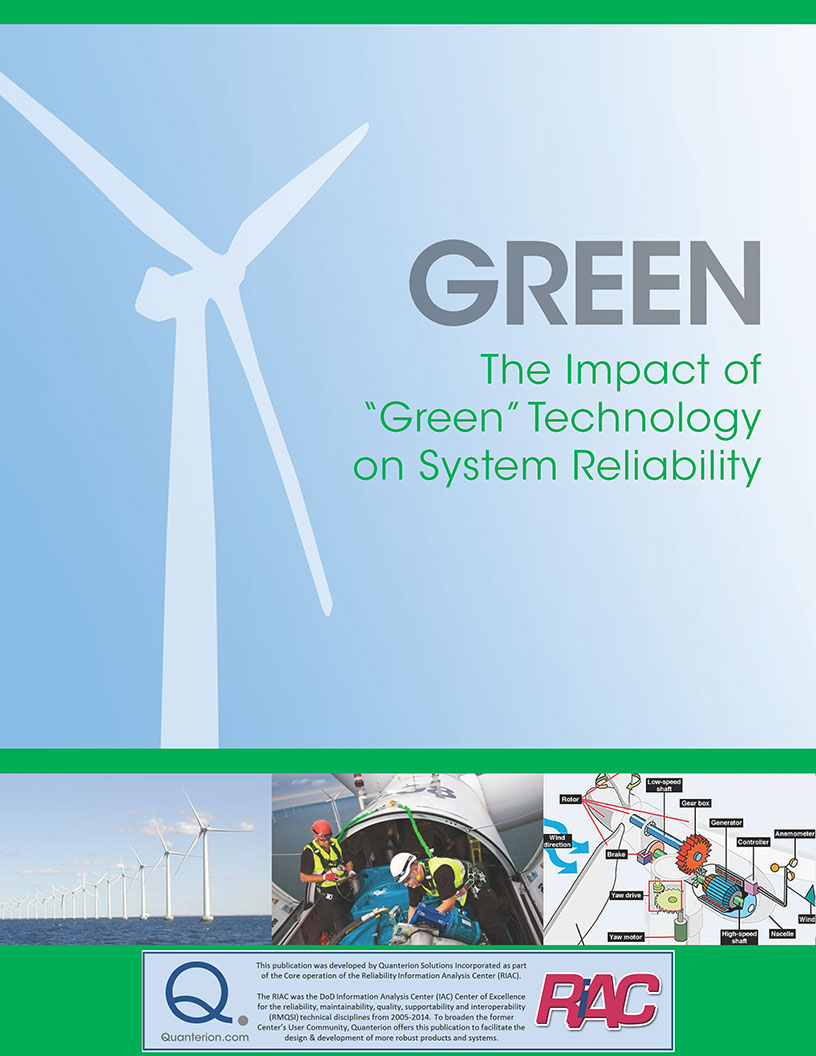
Quanterion has conducted a multi-year study of the reliability of alternative energy technologies as a task under its day-to-day operation of the Reliability Information Analysis Center (RIAC). The study, Green: The Impact of “Green” Technology on System Reliability,which was completed in April of 2012, is focused on the reliability implications of "going green" because, in order to be an effective alternative energy source, the candidate technology must be operationally available (combination of reliability and maintainability) over extended periods of time. Because the designs of many of the candidate technologies are in many cases unproven, the study is providing the necessary information that will enable the reader to better understand the risks of using these approaches. The results will leverage the methodologies and models commonly applied in the reliability evaluation of three of the most mature "Green" power generating technologies: Geothermal, Solar and Wind. Specifically, the technologies covered in the study include:

  • Example Projects:
    • Solar Technology: Solar photovoltaic, Concentrated Solar Power (CSP), and solar heating based systems are being researched to provide an overview of various Solar energy solutions including photovoltaic (PV), Concentrated Solar Power (CSP), and solar heating systems and their applications. Given that the vast majority of solar energy systems currently deployed are based on PV technology, the Solar section will provide emphasis on PV systems. Through life testing, PV modules themselves have been proven to be very reliable, to the point where manufacturers will warranty a module for 10 to 20 years. However, they can still fail or degrade. Yet most PV system reliability issues are concerned with what is termed the 'Balance of System' or BoS, comprised of all other devices in a PV system, other than the PV modules themselves. Due to the almost unlimited variety of actual PV system installations, a reliability review necessitates looking at PV systems at a modular/functional level, as well as from the aspect of the various materials and components used in various PV system applications.
    • Wind Power Technology: Investigation of Vertical and Horizontal wind turbine systems for both on- and off-shore use is revealing that fielded systems are experiencing failures well before their projected 20 year lifespan. The continual demand to produce larger systems capable of greater power generation has led to a significant increase in the operational loads on critical component groups. The majority of unscheduled downtime can be attributed to the gearbox and the turbine blades, two of the system's most problematic elements. This part of the study will identify the predominant failure mechanisms for these components, as well as the conventional and conceptual approaches to mitigating such failures.
    • Geothermal Technology: Geothermal energy for electrical generation and direct-use applications will provide an overview of several geothermal energy solutions, including generation of electricity, direct-use applications and geothermal heat pump installations. The operational and system components for the most common variants of each technology type will be described and the major failure modes identified. Compared to other energy generation technologies, geothermal systems are unique, in that they contain no energy storage capacity. The systems must be operational in order for electricity and/or heat to be generated. Since most of the system downtime can be traced to down-well pumps, steam turbines and geothermal heat pumps, specific attention is being given to the reliability performance of these components, with emphasis placed on major failure mechanisms, precipitating causes and their accelerating factors, and mitigation strategies.
    • Green: The Impact of “Green” Technology on System Reliability: Quanterion conducted a multiyear study of alternative energies under a task on its day-to-day operation of the Reliability Information Analysis Center (RIAC). This project focused on the reliability implications of "going green" because in order to be an effective alternative energy source, the candidate technology must be operationally available (combination of reliability and maintainability). Because the designs of many of the candidates are in many cases unproven, the study provided necessary information to enable the user to better understand the risks of using the approach. The results make use of sharing the methodologies and models commonly applied in the reliability evaluation of three of the most mature "Green" power generating technologies: Geothermal, Solar and Wind power. For each technology, a general overview of the system and its components is provided, with specific attention applied to areas with known reliability concerns. Common failure modes and mechanisms are provided, along with typical evaluation tools or techniques employed. The report is available now at http://www.theriac.org/riacapps/search/?mode=displayresult&id=705

      Many of the RIAC's other publications provide methods, models and data highly relevant to the analysis and selection of operationally available alternative energy systems and the components that comprise them (see http://theRIAC.org).

Copyright © 2000-2013 Quanterion Solutions Incorporated
This site is best viewed in IE 8.0 or higher, Firefox 3.0 or higher, and Google Chrome.